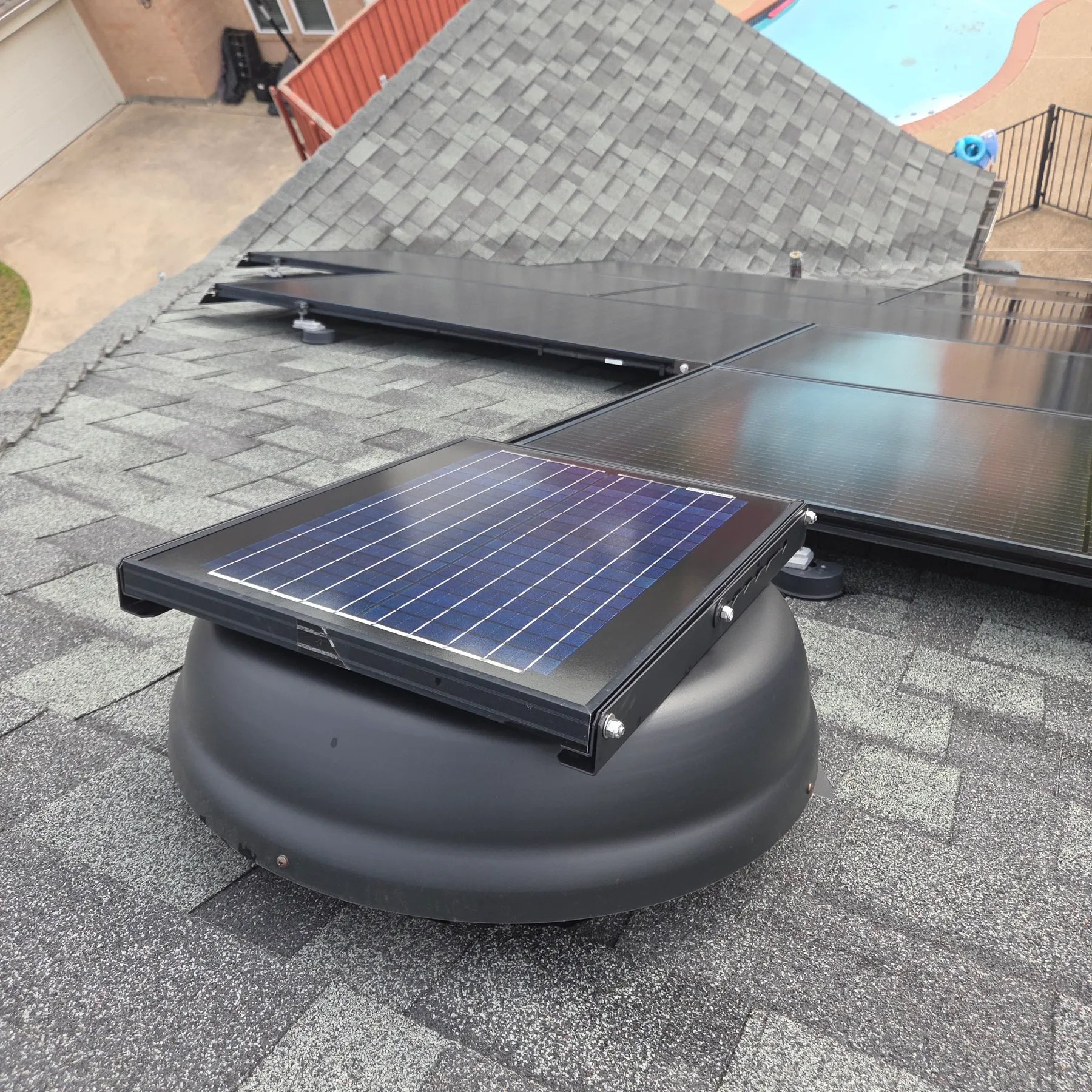
Improve attic airflow and upstairs comfort
Solar Attic Ventilation Fans
Solar-powered attic fans that exhaust trapped hot air using sunlight instead of household electricity — sized to your attic square footage and existing vents.
- Power
- Integrated solar panel
- Sizing guide
- Roughly one fan per 1,000–1,200 sq ft of attic
- Mounting
- Roof-mounted, sealed and flashed
- Night operation
- Only on models with a battery or grid bridge
Why it matters
What attic ventilation actually does for you
Targets hot upstairs rooms
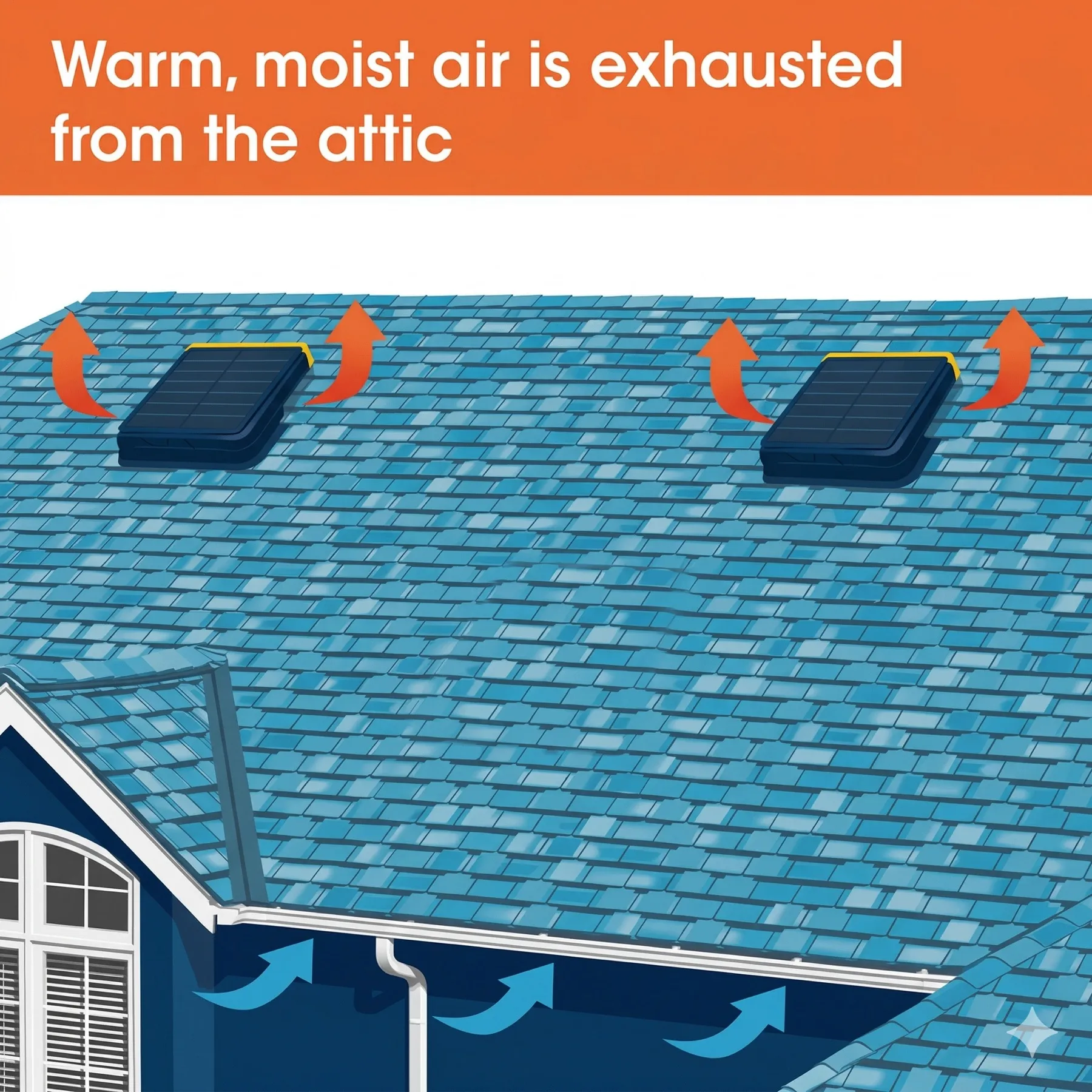
A trapped attic radiates heat down through the ceiling all afternoon. Exhausting that air is the first thing to try.
Runs on sunlight
The fan draws from its own PV panel, so it does not add to your household electric load.
Helps with winter moisture too
Airflow reduces the condensation that collects on cold rafters and leads to mildew and wood rot.
Quiet and low-maintenance
No ductwork, no wiring runs into the house, and nothing to service on a schedule.
The problem
A trapped attic radiates heat down all afternoon
On a North Texas summer day, an unventilated attic gets far hotter than the air outside and holds that heat well past sunset. The ceiling below it becomes a radiator pointed at your bedrooms.
What that feels like downstairs
- Upstairs bedrooms that never match the thermostat downstairs
- The AC running long into the evening after a hot day
- An attic that feels stifling and smells stale year-round
- Condensation or dark staining on rafters in winter
Not just summer
Winter is a moisture problem, not a heat problem
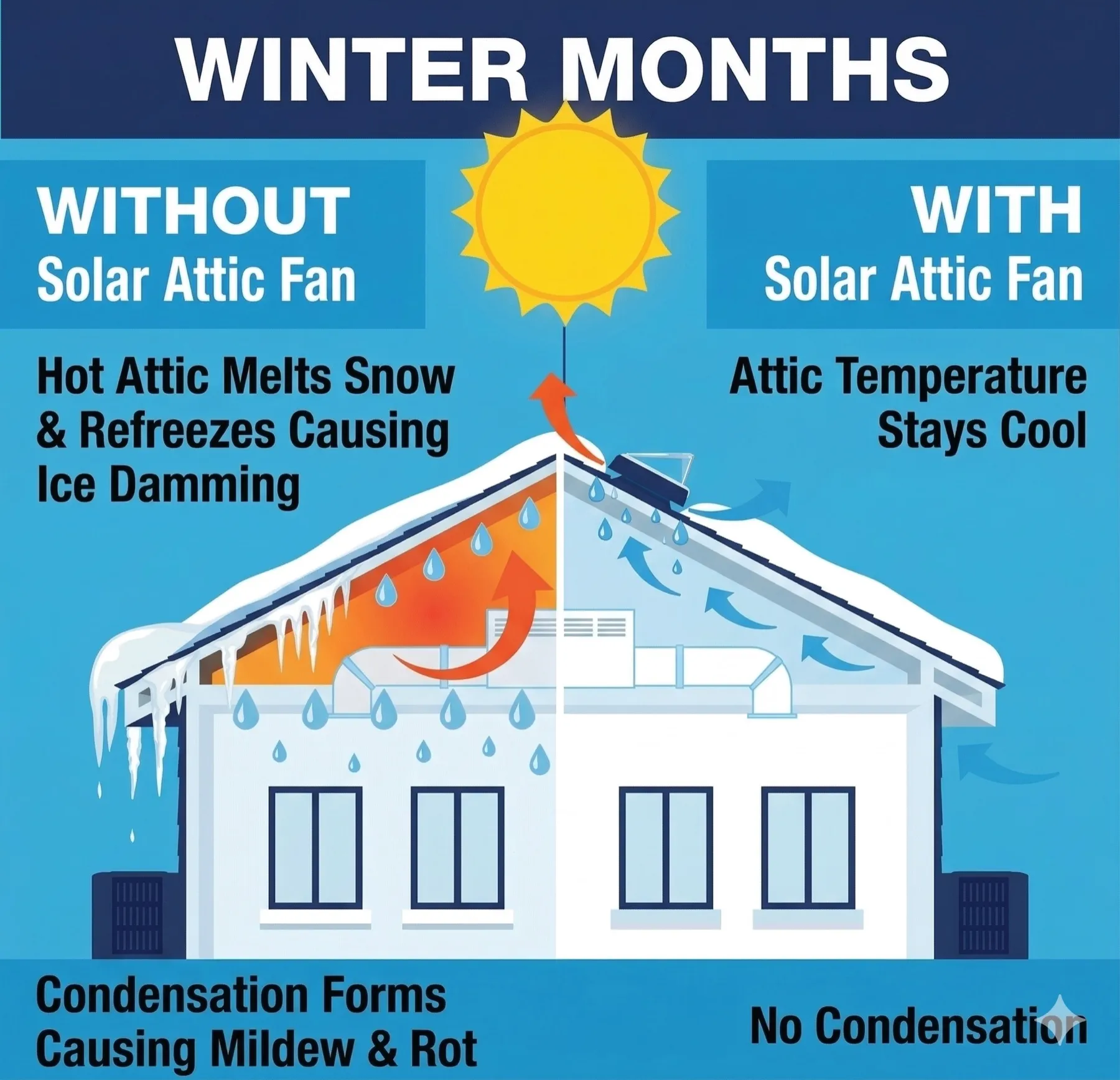
Warm, damp air from the house rises into the attic all winter. With nowhere to go, it condenses on cold rafters — and that is where mildew and wood rot start.
Airflow keeps that moisture moving out instead of settling. It is the less obvious half of why attic ventilation matters, and it is the half that quietly costs you a roof deck.
Ice damming is a real failure mode of a hot attic, though it matters far more in colder climates than it does in Collin County. We mention it for completeness, not as a scare.
Straight answers
What a solar attic fan will and won't do
This is a complementary comfort upgrade, not a miracle. Here is where we draw the line.
- Will it cut my power bill?
- By actively exhausting trapped air, the fan prevents heat from "soaking" into your ceiling and radiating into your living space. This reduces the load on your AC, meaning it runs less frequently and works less hard, typically resulting in a noticeable drop in monthly cooling costs. Exact energy savings vary with your insulation, existing intake venting, and ductwork.
- Is a fan enough on its own?
- Not always. A fan is exhaust, and exhaust needs intake. If the soffit vents are blocked, painted over, or undersized, adding a fan pulls conditioned air out of the house instead of hot air out of the attic. We check intake before recommending anything.
- Will it fix a poorly insulated attic?
- No. Ventilation and insulation solve different problems. If the real issue is thin or displaced insulation, a fan will help less than fixing the insulation, and we will tell you that.
Residential vent options
Choose the Right Solar Attic Vent for Your Roof and Space
A roof mount attic fan is often chosen for broad exhaust coverage across the attic space. A gable mount can be a better fit when roof layout, appearance, or access makes side mounting more practical.
Some homeowners also ask about product lines such as Solatube when comparing solar powered attic fan designs and features. The best choice depends less on the label and more on fit, airflow needs, and installation conditions.
This is not a one-size-fits-all product category. A well-matched solar roof vent should be selected with CFM needs, roof orientation, and ventilation balance in mind so the system works with your home rather than against it.
The install
Roof-mounted, sealed, and running the same day
The fan draws from its own integrated PV panel, so nothing gets wired back into the house and nothing is added to your electric load.
- We check existing intake venting before recommending a fan
- Sized roughly one fan per 1,000–1,200 sq ft of attic
- Mounted on the appropriate roof slope for sun exposure
- Flashed and sealed to the same standard as any roof penetration
- Positioned to work with your array, not shade it or crowd it
- No ductwork, no household wiring, no scheduled maintenance
How it works
What the visit looks like
Inspect, recommend, do the work, review it with you. No surprises added at the end.
Inspection
Inspect the array perimeter, roof type, and access conditions, and check the current intake ventilation and exhaust ventilation.
Recommend
Recommend the right material, attachment method, vent size, and mounting style for the panel frame, module frame, and roof setup.
Install
Complete the installation neatly around exposed edges, sealing the unit for clean roof integration while preserving airflow, drainage, and rain runoff.
Review
Confirm operation, review the finished installation, and explain what to monitor over time.
- Fully Licensed & Insured Insured, bonded, and certified
- Locally Owned Texas-based and family-owned
- Eco-Friendly Products No harsh chemicals, no tap water
- 3,000+ Happy Texas Home Owners Across the Greater DFW Metroplex
Straight answers
Solar Attic Ventilation Fans questions
Do solar attic fans actually lower my electricity bill?
Yes. By actively exhausting trapped air (which can reach 150°F or 65°C), the fan prevents heat from "soaking" into your ceiling and radiating into your living space. This reduces the load on your AC, meaning it runs less frequently and works less hard, typically resulting in a noticeable drop in monthly cooling costs.
Do I really need an attic fan during the winter months?
Absolutely. While you aren't fighting heat in the winter, you are fighting moisture. Solar vents provide the airflow needed to exhaust humid air from showers and cooking that escapes into the attic. Without this airflow, that moisture condenses on cold rafters, leading to mold, wood rot, and the dreaded ice damming on your roofline.
Will the fan still work on cloudy days or at night?
Standard solar vents run when the sun is hitting the panel. While they may slow down during heavy overcast, most high-quality units are designed to operate even in low-light conditions. However, they generally do not run at night unless you choose a model with a "solar-to-electric" bridge or an integrated battery backup.
How many solar vents do I need for my house?
This depends on your attic's total square footage. A general rule of thumb is one fan for every 1,000 to 1,200 square feet of attic space. However, for a roof with a very steep pitch or a complex shape with multiple "pockets," you might need two units to ensure there are no dead zones where air remains stagnant.
Free quote
Get a attic ventilation quote
Answer three quick questions and we'll come take a look. Free quote, no obligation.
Get Your Free Quote Today
Investing in expert solar panel cleaning services not only extends the lifespan of your panels but also maximizes their efficiency. Let us help you get the most out of your renewable energy investment in Allen and throughout North Texas.